Interesting...
I salute Mr. Am for putting his time and effort (and probably some cold hard cash as well) into something most people only talk about.
Showing posts with label New Atlantis. Show all posts
Showing posts with label New Atlantis. Show all posts
Friday, April 1, 2011


Sunday, October 10, 2010
The Human Factor…
Possibly the biggest obstacle to the creation of New Atlantis is not the construction or the engineering that goes along with it, but is instead the opposition to any such undertaking by other states.
One only need examine the virtual freeze-out internationally of the relatively peaceful Republic of Somaliland in a part of the world known for its anarchy and violence to realize that the creation of new states is frowned upon in the extreme.
There are also the various other anti-man ideals to contend with. The UN who has overstepped its role as an arbitrator between nation states to don the mantle of global caretaker, claiming de-jure if not de-facto control of all oceans not controlled by specific national entities. The various environmental and ecological busybodies who would think nothing of rallying their illogical forces to put the existence of some marginal aquatic slug or coral over and above the right to life of any who choose to join in this venture.
In order to mitigate this opposition (and others) several things are required.
- New Atlantis must be established outside of the exclusive economic zone of any nation.
- The initial construction must be done quickly and in secret
- We must strive to meet all the defined requirements of a sovereign state as soon as possible
- We must be ready and willing to defend what we build
- The discovery seamount chain is approximately 722km (390 nautical miles) from the nearest land (Gough Island) and as far as I can tell, quite outside of the claimed EEZ.


- In order for some realistic claim to sovereignty actual physical inhabited space must exist. The often maligned micro-nation of Sealand demonstrates that “land” per se does not mean tera firma, only that there must be a space for people to claim. A boat will not suffice, an actual structure connected to the earth must be created. Luckily the seamount is within 6 feet of the surface at its highest point. This means that a large rock or some sort of man made structure can be put on the seamount to establish the “land” requirement. From that point the construction of the polder should be undertaken and progress as quickly as possible.
- A Sovereign State is a state with a permanent population, a defined territory, a government, and the capacity to enter into relations with other sovereign states. It is also normally understood to be a state which is not dependent on, or subject to any other power or state.
i. This definition poses certain problems for New Atlantis. First of all the requirement for a permanent population means that at least some of the settlers must immediately become citizens and NOT leave the site. I would imagine that creating a small self-sustaining habitat with the necessities for life, shelter, food and water would go a long way to proving and legitimizing any claim to the area.
ii. Defining the territory could be done with bouys and simple mapping of the seamount itself. This is work that would be required for building anyway. It would also include the establishment of our own EEZ and perhaps necessitate the establishment of a maritime patrol of the area we claim. It is important to note that the Discovery Seamount Chain is comprised of several tablemounts which would provide for future expansion.
iii. The requirement for a government is important and in order to make a reasonable claim to having one we would require a constitution, perhaps codified laws and the people to make it up. Now this doesn’t have to be anything more complex than you would see in a small incorporated village but it must exist and it must be in legitimate control of the use of retaliatory force. I would argue that this would call for people to swear some sort of oath of citizenship, formally acknowledging the state.
iv. The ability to enter into relations with other states might prove problematic but I think it could be overcome. The site is located off the coast of Africa and relatively near to some of the poorest nations on earth. If we were able to sign a contract with one of them for trade so we could buy our essential supplies from them then we will have fulfilled that requirement. Money talks and a state like Namibia needs all the foreign money it can get.
v. As for not being dependent on another state that goes back to the necessity for a self-sustained habitat. It also speaks to our next problem… defence.
- The fate of the Republic of Minerva shows that in order to succeed we must be willing to fight. Now there isn’t a hope in hell that a group of private individuals will be able to militarily defeat a formed nation, but we have to think outside the box.
- The first thing should be the use of the media. Once discovered we should begin an information campaign to humanize the settlers to make the people outside of New Atlantis care about this project. There are any of a number of ways of doing this but to speak to our core principles of freedom, liberty and self-determination would be best. We’d need a human face, perhaps a family to represent us to the world. This means we would have to have communications and the ability to reach in some way the web to make use of YouTube, Twitter, blogs, Reason TV, ARI(?) etc. This might mean that we would have support on dry land in some country that could upload and post things for us.
- We would need to be armed and be willing to fight, all of which would have to be uploaded to the net as well so that people could see for themselves (and hopefully protest) the heavy handed response of world governments.
- We would need some sort of maritime patrol as stated earlier. This could be as simple as a converted civilian ship to start, in much the same fashion as was done by many countries at the outbreak of WW1 & 2
- A standing militia would be nice with uniforms and common weapons. All of this military stuff also boosts the legitimacy of our claim to nationhood as well.
Ayn Rand said "Civilization is the process of setting man free from men." well that is what this is all about. But I'm not so naive to believe that they are going to let us be free without a fight.
Well that’s all my ideas on this for now. I’ll write more later.
Monday, September 6, 2010
Seacrete/Biorock... Construction solution
Seacrete is the end product Electro-Accretion, a process similar to electroplating in which calcium carbonate is encouraged to accumulate on an electrified metal frame. The process essentially creates man-made Limestone. This end result leads to (at least) two possible uses.
The first is using the process to create solid sheets of calcium carbonate from 1/2 inch wire fencing or some similar frame. The sheets would then be used in construction of the polder and later shelters and other pieces of infrastructure.
Underwater construction of the polder then consists of building and anchoring a metal frame to the top of the seamount, and charging it with electricity. The electro-accretion then takes over and after a number of weeks a solid structure constructed of man-made limestone has replaced the flimsy wire frame. The best part of this is as long as the electrical charge is going into the frame the electro-accretion continues, making the structure stronger and stronger.
I think the polder construction could be completed in roughly this sequence.
More to follow...
The first is using the process to create solid sheets of calcium carbonate from 1/2 inch wire fencing or some similar frame. The sheets would then be used in construction of the polder and later shelters and other pieces of infrastructure.
Underwater construction of the polder then consists of building and anchoring a metal frame to the top of the seamount, and charging it with electricity. The electro-accretion then takes over and after a number of weeks a solid structure constructed of man-made limestone has replaced the flimsy wire frame. The best part of this is as long as the electrical charge is going into the frame the electro-accretion continues, making the structure stronger and stronger.
I think the polder construction could be completed in roughly this sequence.
- The top of the seamount where the polder is going to rest is cleared down to the bedrock. All the debris is piled toward the center of the seamount.
- Iron piles are driven into the top of the seamount - these piles will serve as anchors for the wire mesh and add to overall structural strength.
- Wire mesh frames are assembled in sections on board a barge or similarly open decked boat. They are built so that the end result is a 3 sided box with the future "land side" left open. These are lowered over the piles and attached (wired) together.
- The bottom of the wire structure is made to conform as tightly as possible to the seamount bedrock and is fastened to it on all 3 sides with metal fasteners, like cement nails driven directly into the rock. They are also wired to the piles.
- The entire structure is then electrified by the use of Swellfuel's ingenious ocean wave energy converter. I've chosen these wave power devices because of their small size, their portability and their autonomous operation.
- Once the process of electro-accretion has created a solid limestone structure out of the wire mesh frame a dredge is used to fill the 3 sided boxes. Seacrete sheets are attached to the piles on the land side as the frames are filled. Once the frames are filled up to sea level another layer of wire mesh is applied directly over the Seacrete sheets on the land side end. This too is electrified and soon becomes a solid sheet.
- With the box closed on all sides more debris is dredged and deposited into the frame from the top. This is done until the material in the frame is compacted and solid
More to follow...
Tuesday, April 20, 2010
Pertinent Questions
AMAI, a "friend" of this blog asked these questions about the possibility of reclaiming a Seamount. Her scepticism is understandable and I'll do my best to explain.
How much space is needed?
I would ask a question in rebuttal... How many people would come? At the outset I honestly can not see more than a relative handful of true pioneers upping stakes and striking out to set up a colony in the middle of the ocean somewhere. Their requirements for space would be limited but those requirements would grow as the colony became established. From the information Steve found (and relayed in the comments here) a single square kilometer ought to be able to support about 250 people.
Keeping in mind that that is a self-sufficiency number not a construction number. Certainly during construction when all food and supplies are being brought to the site 250 people could live in much less space than 1 square kilometer. Like a single large-ish ship/working platform.
I'd also like to point out that that is using modern traditional farming methods, not something more space efficient like hydroponics.
How many people are needed at start-up?
I would like to say the more the merrier but that is not quite right. The correct answer right now is that I don't know. But if I had to guess I would say that there is probably a number that would give economy of scale between the goods that must be brought in to the site to support the workers and what must be brought in for the construction itself. I would put the number of workers (on site) somewhere between 50 and 100. Supported by half that number off site in more logistical roles, but as I said at this point that is speculation, pure and simple.
How many people are going to be able to join in later?
I have no clue but I am willing to bet that if Rome circa 44 BC had a population of over 1,000,000 then the possible population could be quite high. Of course the other question again, is how many would come?
What kinds & amounts of provisions are needed at start-up?
The basic necessities, food, water and shelter. Enough for the number of people working on the colony.
What is the safest way to obtain interim provisions?
By ship.
What kind of product/good/service can be produced/offered to earn money and to whom shall it be offered?
I honestly consider this to be somewhat of a red herring. What sort of product/good/service could be offered in Hong Kong or the Seychelles? What about the services offered in your local mall?
Off the top of my head I would say anything and everything from Secure Data Storage to Offshore Financial Services, Basalt Mining and processing to Aquaculture and traditional fishing.
All this you understand while construction continues ...
I disagree with this statement. While the initial construction is ongoing the necessities will have to be shipped in from elsewhere. It does not make any sort of sense to be trying to establish an agricultural base while the main focus is on reclaiming land from the ocean. Once a couple polder have been established then we can think about weaning ourselves off of foreign dependences, but until then, we must trade for what we need. No, this is not a cheap option.
The one question that AMAI didn't ask was how much it will cost? I believe that to be the biggest stumbling block. Aside from the fairy tale happenstance of Bill Gates donating a couple of million/billion dollars in seed money to the Colony, sadly, I don't have any possibility of trying this on my own. Although there are some thoughts on funding such a venture that I will explore in another post some time.
Monday, April 5, 2010
Design Continued
With the construction of successive seawall enclosures or polder (to use the Dutch word - thanks to Steve for reminding me of it) in a line and backing up the seaward polder with at least another row it becomes easy to see that at a certain point you would not have to settle for 1km square habitats, but instead could effectively wall off relatively large areas. The diagram below represents a total inside area of 100 square kilometers (each outer square representing a 1km square polder).
This design also lends itself nicely to the creation of neighbourhoods.
The drawing once again is a simplified plan, there is nothing saying that the plder would be uniform in shape or lined up with military precision. The shape would in fact probably be dictated by the ground, with the outer polder following the shallower portions of the top of the seamount where possible.
Of course the seamount presents a finite amount of space, and while initially the design might follow that model, if successful there would no doubt be a push to reclaim the entire usable surface of the seamount.
H/T again to Steve for his contributions on another means.
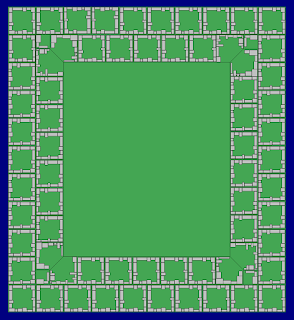
This design also lends itself nicely to the creation of neighbourhoods.
The drawing once again is a simplified plan, there is nothing saying that the plder would be uniform in shape or lined up with military precision. The shape would in fact probably be dictated by the ground, with the outer polder following the shallower portions of the top of the seamount where possible.
Of course the seamount presents a finite amount of space, and while initially the design might follow that model, if successful there would no doubt be a push to reclaim the entire usable surface of the seamount.
H/T again to Steve for his contributions on another means.

Sunday, April 4, 2010
Design Considerations
I am going to preface this with a simple statement. I am not and do not pretend to be an engineer of any sort. What I know I have cobbled together from limited (though increasing) reading on various subjects concerning the building of breakwaters, dams and dikes and the forces that act upon those structures.
The single overriding factor in the construction of this sea wall to me has to be the force exerted on it by waves. If it were just a matter of water then one would only need to replicate any hydro electric dam or reservoir and call it a day. But the fact is that oceanic wind and water waves are a constant factor in erosion and a continuous pounding force on any fixed structure in the ocean.
This leads me to some conclusions.
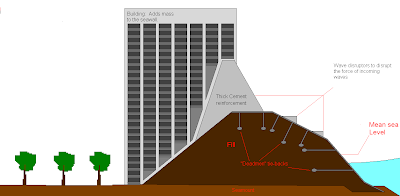
The single overriding factor in the construction of this sea wall to me has to be the force exerted on it by waves. If it were just a matter of water then one would only need to replicate any hydro electric dam or reservoir and call it a day. But the fact is that oceanic wind and water waves are a constant factor in erosion and a continuous pounding force on any fixed structure in the ocean.
This leads me to some conclusions.
- You won't be able to just dump a bunch of fill on the top of a seamount and expect to have a permanent solid watertight structure like the libertarians did at Minerva Reef (which has since disappeared under the water again).
- The structure needs to have an armoured shell on the seaward side. I believe due to the forces acting upon the structure that this armour should be monolithic, which is to say, continuous and unbroken. There are methods of armouring like tetrapods but I believe this type of reinforcement would take up more space and be more expensive in the long run that using a product like steel sheet piles. This armouring must also incorporate "toe protection" in order to not be undercut by the action of waves at the foot of the structure.
- The structure needs to be constructed in such a way as to mitigate wave forces. There are many ways of doing this. First and foremost is the shape of the structure. A rounded form will prevent much of the direct pounding force of the waves, a sloped turtle like shape will allow waves to more gently roll up the sides of the seawall rather than slam into it as they would for a perpendicular wall. Other wave mitigation features include breakwaters built on the seaward side, driving wave break pilings (which force waves to "break" before reaching the actual structure) and incorporating random protuberances into the face of the structure itself to further break up incoming waves. I would suggest a combination of all three, using breakwaters to form suitable harbours on the seaward side of the structure as required and employing the others for the protection of the rest.
- The larger and more robust the sea wall the safer the entire project will be. I'm imagining a seawall at least 50 meters wide before there is any sort of infrastructure. This isn't wasted space though, as I alluded, it could be used for harbours and ports to tie up ships, and ideally the space would be a sort of beach front during pleasant weather.
- Using buildings lining the inside of the seawall to add mass and stability to the land side of the seawall would further increase the strength of the structure. It would also utilize space more efficiently allowing for the actual reclaimed land to be used for more productive efforts, like growing food and offering space to the colonists.

Saturday, April 3, 2010
New Atlantis - Part 1 - Why there?
Long before I read about the ancient city of Seuthopolis I though about the possibility of creating new land on the top of a Seamount by building a large dike and then pumping out all the water.
There are (in my opinion) several advantages to this idea over any other possibility to create a LFC society on this planet.
1. There is no one who can be said to "own" the property in question. Yes, the United Nations Conventions on the Law of the Sea (UNCLOS) do have provisions dealing with construction in international waters, but these are with regard to being "hazards to navigation" and, well a shallow Seamount is already a hazard to navigation. The construction of a visible structure would actually be less of a hazard to navigation.
The UN extends its greasy fingers in further under misguided nonsense about protecting fragile habitats, but I would argue that one single solitary Seamount measuring a total of 160 square kilometers is no loss in an ocean comprising 361.132 million sq km.
2. The remoteness of some of these Seamounts would enable building to begin and possibly go on for quite some time before the settlement would be "discovered" by the outside world. Yes, I know there are satellites in space that can read the newspaper lying on your front porch but the only reason they are zooming in is because there is a front porch there in the first place. How much time and at what sort of resolution do you think satellites spend scanning that 361 million square kilometers of ocean?
This also reduces significantly the possibility of Greenpeace or the Sea Sheppard society from instantly being aware of the destruction of the aforementioned "delicate ecosystem"*1.
3. The logistical effort and the necessity of creating such a huge structure would create an instant economy. Where there is work there is commerce, people trading value for value, people filling all the niches of a full blown market from the guy making and handing out sandwiches at the job site to the guy running the company hauling material from the mainland to the site itself.
4. The fact that the builders and settlers would be completely removed from any outside influences would be invaluable to the creation of and development of a truly LFC society.
The undertaking would be immense, it would include the development of the first truly objective code of law in the history of man. The creation of an explicitly laissez faire constitution and the separation of economics and state.
In my opinion this would be much easier and more likely to succeed without any external international pressure. With the world moving closer and closer to collectivism the freedom to develop outside of all that influence and those who would wield their considerable power against that ideal is of immeasurable value.
I'm sure there are some reasons I haven't thought of, but in my mind these would be the most important, especially the time and space to make it happen. When the USA won the War of Independence the world was a different place, it took weeks to cross the Atlantic. This simple fact allowed the Fathers of the American republic to develop their county in practical isolation, to come as close to the LFC ideal as was possible in their day and age.
That is the kind of isolation I wish for, for New Atlantis. The time and space to make a new start.
*1 - I should mention that in the design of the structure it would be beneficial for it to be constructed in such a way that it would encourage more aquaculture to live there. This could be achieved by having a non-uniform exterior on the sea-wall. This would encorage the growth of corals and provide habitat for fish and marine plant life. An irregular shell on the sea-wall also helps dissipate wave forces in the same way that Tetrapods do.
Subscribe to:
Posts (Atom)